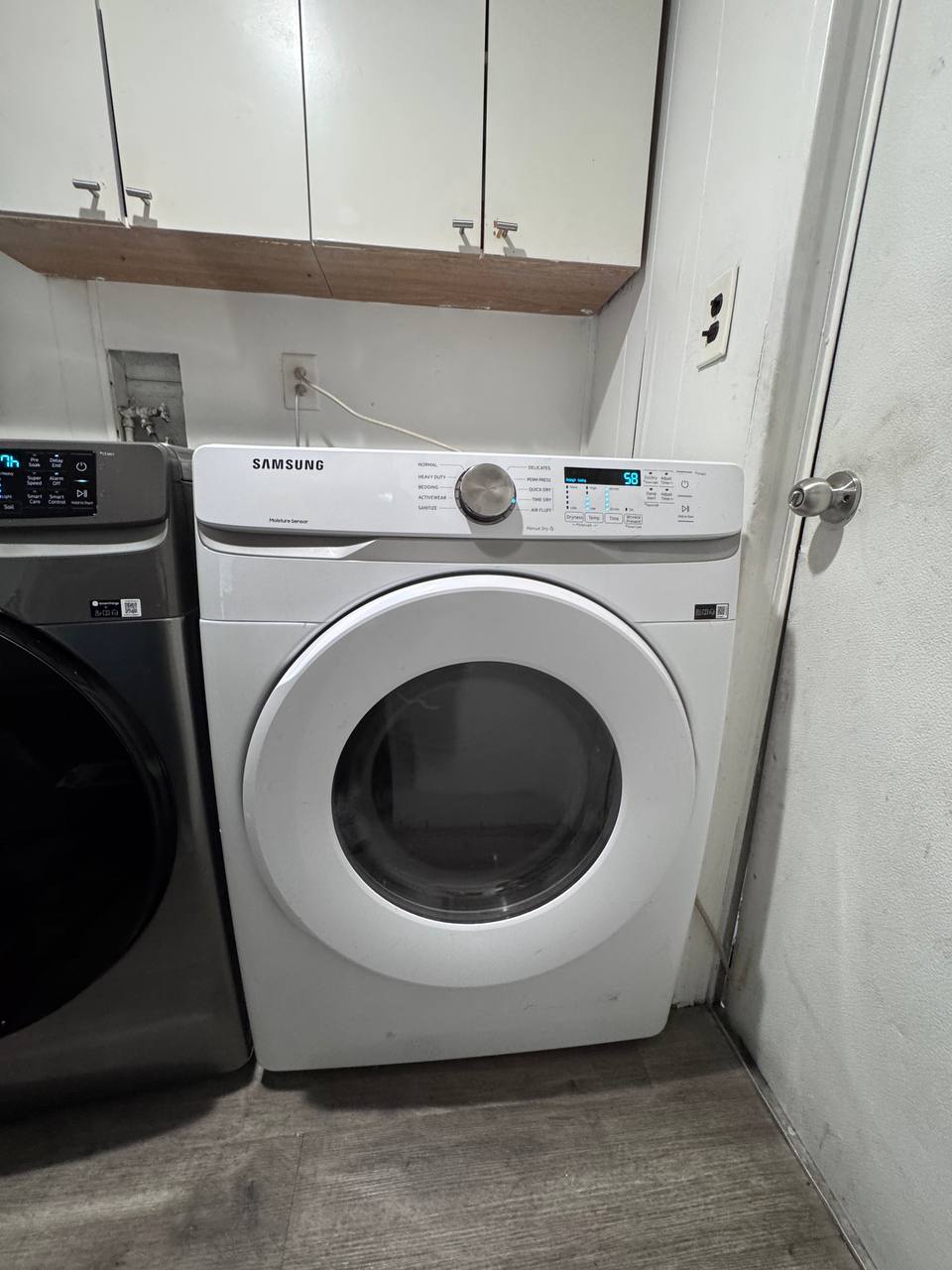
When a modern digital dryer turns on, chimes, and lights up its console, most homeowners assume the electronics are functioning normally. However, when pressing the Start button produces nothing—no motor engagement, no drum rotation, and no heat—the machine has almost certainly entered a protective safety lockout. On Sunday morning, our service van headed to a residential home in Dania Beach to troubleshoot a Samsung dryer exhibiting this exact symptom.
The Initial Assessment
Upon arrival, the homeowner demonstrated the issue: the Samsung dryer powered up properly, allowed cycle selection, but when the Start/Pause button was engaged, there was only a quiet relay click from the main control board, followed by complete silence. The motor never received line voltage to roll the drum, and the heating element stayed inactive.
In Samsung dryers, this lockout behavior points directly to the drive motor circuit, which routes power through critical temperature-limiting safeties. We isolated the unit from electrical power and removed the front bulkhead to inspect the internal chassis and components.
Heavy Internal Lint Accumulation
Once inside the cabinet, we discovered heavy lint compaction around the blower housing, drive motor, and heater duct. While the homeowner regularly cleared the screen filter, accumulated fiber had leaked past internal seals, restricting critical airflow and creating a serious fire hazard.
Thermal Cut-Off Continuity Test
Using a digital multimeter set to ohms, we tested the thermal fuse mounted on the blower housing. The meter displayed infinite resistance (open circuit / O.L.). A blown thermal fuse interrupts power to the drive motor circuit, immediately preventing the dryer from running at all.
Root Cause: Thermistor Resistance Drift
A thermal fuse never blows without an underlying trigger. Testing the heating element revealed intact coils with no short to ground. We then tested the thermistor (temperature sensor). At room temperature (~75°F–77°F), a standard Samsung NTC thermistor should read roughly 10 kΩ. Our multimeter measured 23 kΩ. Because resistance drops as temperature rises, a 23 kΩ reading tricked the main control board into thinking the drum was excessively cold. The control board commanded constant, uninterrupted heating until cabinet temperatures breached safe limits, forcing the thermal fuse to blow to prevent an open fire.
The Repair & Fire Hazard Remediation
Addressing only the thermal fuse would have resulted in another blown fuse within 24 to 48 hours. A complete, permanent repair required eliminating both the underlying sensor failure and the airflow restriction:
- Cabinet Decontamination: We thoroughly vacuumed the internal base, blower housing wheel, and heater assembly to restore unimpeded CFM airflow and remove combustible lint.
- Thermistor Replacement: Installed an OEM Samsung thermistor calibrated to proper baseline resistance curves.
- Thermal Fuse Replacement: Installed a new OEM thermal cut-off rated to factory thermal specifications.
After reassembling the drum, drive belt, idler pulley, and front bulkhead, we initiated a timed diagnostic cycle. The motor engaged immediately, the drum rotated smoothly, and heating cycled accurately as the new thermistor communicated precise internal temperatures back to the main PCB.
Preventing Dryer Thermal Failures
A blown thermal fuse is an emergency safety measure, not the primary defect. If your Samsung dryer unexpectedly stops spinning or heating, always have a certified technician test the thermistor and exhaust ventilation before simply swapping fuses.